2026 FIFA World Cup draw
what it reveals, what it risks, and what lovers of football should watch out for

2026 FIFA World Cup draw — what it reveals, what it risks, and what lovers of football should watch out for
December 5, 2025 will be remembered not just for a draw, but for a statement. At a glitzy ceremony in Washington, D.C., the draw for the 2026 World Cup formally launched the global journey for 48 nations. It is, by far, the boldest expansion of football’s showpiece in history both in scope and in consequences.
The politics and pageantry that accompanied the draw from celebrity hosts, showbiz-style presentation, to the spotlight on national leaders underscored a central fact: this is no longer just a sports tournament. It’s a massive spectacle. In that context, the draw was as much about shaping perception of grandeur, global inclusivity, and the commercial promise of world soccer as it was about grouping teams.
New Structure, a New World Cup
The shift from 32 to 48 teams transforms the tournament in fundamental ways. Now, 12 groups (A to L), each with four teams, will compete, a format designed to accommodate more nations while preserving manageable group sizes.


Under the new rules, groups are drawn from four “pots.” Pot 1 contains the three co-hosts (United States, Canada, Mexico) plus the nine highest-ranked teams in the world. The remaining teams — along with placeholders for nations still to qualify via playoffs — are sorted into Pots 2 through 4.
There are safeguards to maintain some competitive balance. For instance, teams from the same confederation generally cannot be placed together with the only major exception being European (UEFA) nations. Also, a new rule ensures that the top-four ranked teams (excluding hosts) are drawn into separate halves of the knockout bracket. In other words: the earliest we might see a clash between titans like Argentina national football team, Spain national football team, France national football team or England national football team is the semifinal assuming they all progress.
This new architecture reflects a balancing act: opening the world’s biggest tournament to more countries giving underdogs, newcomers, and lesser-known footballing nations a shot at the global stage while trying not to dilute the quality or create unwatchable mismatches.
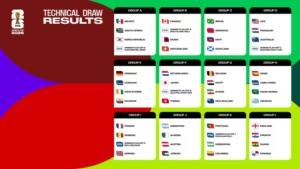
What the Draw Actually Delivered
The draw results mixed the familiar with the speculative. Hosts were pre-assigned their groups: Mexico in A, Canada in B, USA in D. The rest of the groups are now a blend of heavyweights, mid-tier teams, and placeholders highlighting just how unpredictable this World Cup might be.
Already, some “groups of interest” stand out. As reported:
A group featuring Europe powerhouses will be deliberately structured so they don’t meet until late — a design that could preserve the drama for the knockout rounds.
On the flip side, groups containing playoff placeholders (i.e. teams that haven’t even qualified yet) bring uncertainty: strength and identity of several group participants remain unknown.
More nations will be in the mix than ever before, a welcome sign for global representation, but also a challenge for organisers, especially given logistics across three host nations and multiple time zones.


